Summary:-
Corporate Tax for Free Zone Companies UAE allows eligible businesses operating in Free Zones to benefit from a 0% corporate tax rate on qualifying income while still complying with UAE Corporate Tax regulations. Companies that qualify as a Qualifying Free Zone Person (QFZP) and meet the prescribed conditions can enjoy this tax benefit on their qualifying income.
The UAE introduced a two-rate corporate tax system for Free Zone businesses to distinguish between qualifying and non-qualifying income. A Free Zone company that meets the requirements of a Qualifying Free Zone Person (QFZP) can benefit from a 0% corporate tax rate on qualifying income, while non-qualifying income is generally taxed at 9%. Understanding this framework is essential because a single compliance mistake can affect the entire tax position of a Free Zone entity.
The UAE Corporate Tax regime applies to financial years starting on or after 1 June 2023, applies to most businesses, including Free Zone companies. However, the tax treatment depends on whether a company satisfies the conditions established under the Federal Corporate Tax Law and Cabinet Decision No. 139 of 2023.
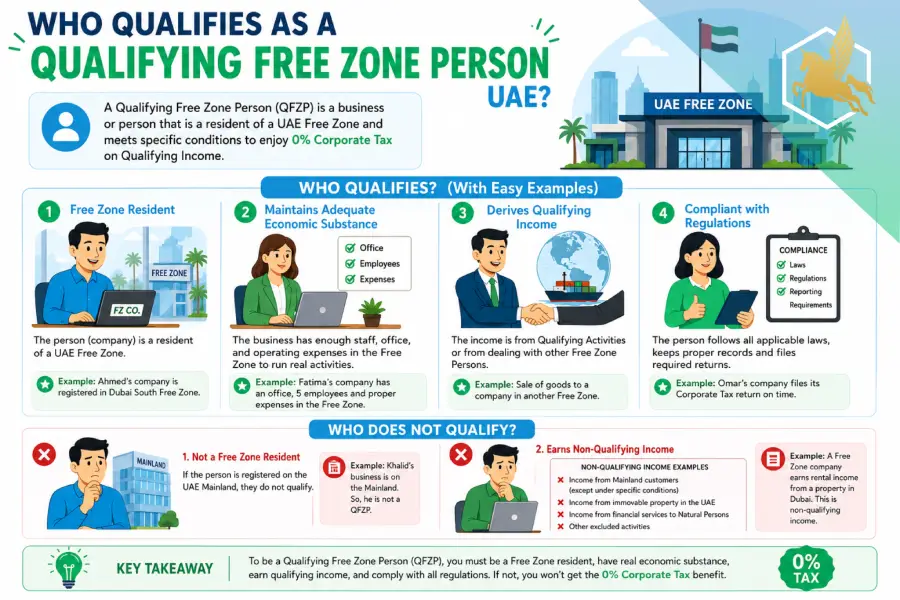
Who Qualifies as a Qualifying Free Zone Person UAE?
A Qualifying Free Zone Person UAE is a Free Zone company that satisfies specific legal and operational conditions set by the Federal Tax Authority (FTA). A QFZP can access a 0% tax rate on qualifying income while remaining subject to UAE Corporate Tax regulations.
To qualify, a Free Zone company must:
- Be incorporated or registered in a UAE Free Zone.
- Maintain adequate economic substance in the UAE.
- Earn qualifying income as defined under UAE regulations.
- Comply with transfer pricing requirements.
- Prepare audited financial statements.
- Not elect to be taxed under the standard corporate tax regime.
- Meet all requirements under the UAE Free Zone Corporate Tax Rules.
A company operating in DMCC, DAFZA, JAFZA, ADGM, or other UAE Free Zones must continuously satisfy these conditions to preserve QFZP status.
What Counts as Qualifying Income for Corporate Tax in the UAE?
Qualifying income refers to income that remains eligible for the 0% corporate tax rate available to a Qualifying Free Zone Person.
Examples of qualifying income include:
- Transactions with other Free Zone entities.
- Income derived from qualifying activities listed under Cabinet Decision No. 139 of 2023.
- Certain passive income streams such as dividends and shareholding gains.
- Export-related transactions conducted outside the UAE mainland.
- Distribution activities conducted from Designated Zones.
- Logistics and supply chain services linked to qualifying activities.
For many businesses, qualifying income forms the foundation of the 0% Corporate Tax for Free Zone Companies UAE framework and creates significant tax efficiencies when structured correctly.
What Counts as Non-Qualifying Income and Why It Creates Risk?
Non-qualifying income is income that does not meet the conditions for preferential Free Zone tax treatment. This income is generally taxed at 9% and can create substantial compliance risks.
Examples include:
- Banking activities.
- Insurance activities other than reinsurance.
- Ownership or exploitation of intellectual property assets.
- Certain finance and leasing activities.
- Transactions with natural persons unless specifically exempted.
- Income from excluded activities defined by UAE regulations.
The biggest risk is that excessive non-qualifying income can jeopardize QFZP status. Once a company breaches the permitted limits or fails regulatory requirements, the tax consequences can extend beyond a single transaction.
Corporate Tax Rates for Free Zone Companies
Qualifying Free Zone Person (QFZP)
A Qualifying Free Zone Person benefits from:
- 0% Corporate Tax on qualifying income.
- 9% Corporate Tax on taxable income that does not qualify under Free Zone rules.
This structure makes the Corporate Tax for Free Zone Companies UAE regime highly attractive for businesses involved in manufacturing, logistics, holding activities, and international trade.
Non-Qualifying Free Zone Person (NQFZP)
- 9% Corporate Tax on taxable income.
Once a company becomes an NQFZP, the tax benefits associated with Free Zone status may no longer apply, significantly increasing the company’s tax exposure.
What Are the Qualifying Activities for Free Zone Tax Benefits?
Cabinet Decision No. 139 of 2023 identifies specific activities eligible for Free Zone tax advantages.
Qualifying Activities
- Manufacturing
- Processing of goods or materials
- Holding of securities
- Ship ownership and operations
- Reinsurance services
- Fund management
- Wealth and investment management services
- Headquarter services
- Treasury and financing services for related parties
- Aircraft financing and leasing
- Distribution of goods within Designated Zones
- Logistics services
- Ancillary activities supporting qualifying activities
These sectors were selected because they contribute directly to the UAE’s diversification strategy and international competitiveness.
List of Excluded Activities for Free Zone Tax Benefits
Certain activities are specifically excluded from preferential tax treatment.
Excluded Activities
- Banking services
- Insurance activities except reinsurance
- Most finance and leasing activities
- Intellectual property ownership and exploitation
- Transactions with natural persons, except permitted categories
- Ownership or exploitation of immovable property outside qualifying conditions
- Ancillary activities linked to excluded activities
Companies generating income from these activities should conduct a detailed tax review before relying on Free Zone tax benefits.
What Happens When QFZP Status Is Lost?
Loss of QFZP status can significantly increase a company’s tax liability. A company that fails to satisfy qualifying conditions may become a Non-Qualifying Free Zone Person and lose access to the 0% tax regime.
Common triggers include:
- Failure to maintain adequate substance.
- Breach of transfer pricing requirements.
- Failure to prepare audited financial statements.
- Excessive non-qualifying income.
- Non-compliance with FTA regulations.
Free Zone Corporate Tax UAE: Compliance Requirements
Every Free Zone company must register for Corporate Tax, maintain accounting records, file annual tax returns, and comply with transfer pricing documentation requirements where applicable.
Businesses often assume that Free Zone registration automatically guarantees tax exemption. The question “Are Free Zone Companies Tax Exempt in UAE” can only be answered after assessing QFZP eligibility, income sources, and compliance obligations.
Conclusion
Corporate Tax for Free Zone Companies UAE provides significant tax advantages for businesses that meet the requirements of a Qualifying Free Zone Person (QFZP).Companies earning qualifying income and maintaining compliance with UAE Corporate Tax regulations may benefit from a 0% corporate tax rate, while non-qualifying income is generally subject to 9% tax. Because QFZP status depends on meeting specific conditions related to substance, reporting, and qualifying activities, businesses should regularly review their operations and compliance obligations to preserve their Free Zone tax benefits and avoid unexpected tax liabilities.
Reach out to Unicorn Global Solutions L.L.C for a Free Consultation
Frequently Asked Questions (FAQs)
Yes. All Free Zone companies are subject to UAE Corporate Tax legislation, although qualifying income may benefit from a 0% tax rate.
A QFZP satisfies all regulatory requirements and may access 0% tax on qualifying income. An NQFZP is generally subject to 9% Corporate Tax.
Activities are classified as qualifying activities, excluded activities, and other taxable activities.
Qualifying income earned by a QFZP is taxed at 0%.
Income attributable to domestic or foreign permanent establishments is generally subject to standard Corporate Tax treatment.
The treatment depends on the property type, location, and transaction counterparties.
Exports generally qualify for favorable tax treatment when they meet qualifying income conditions.