
Summary:-
A Gold Refinery Business in UAE requires obtaining the appropriate industrial and trading licenses, securing a compliant facility, and meeting customs, VAT, and anti-money laundering (AML) obligations before commencing operations. For example, businesses refining scrap gold must maintain transaction records, verify supplier documentation, and comply with UAE regulations governing precious metals processing, import, export, and distribution.
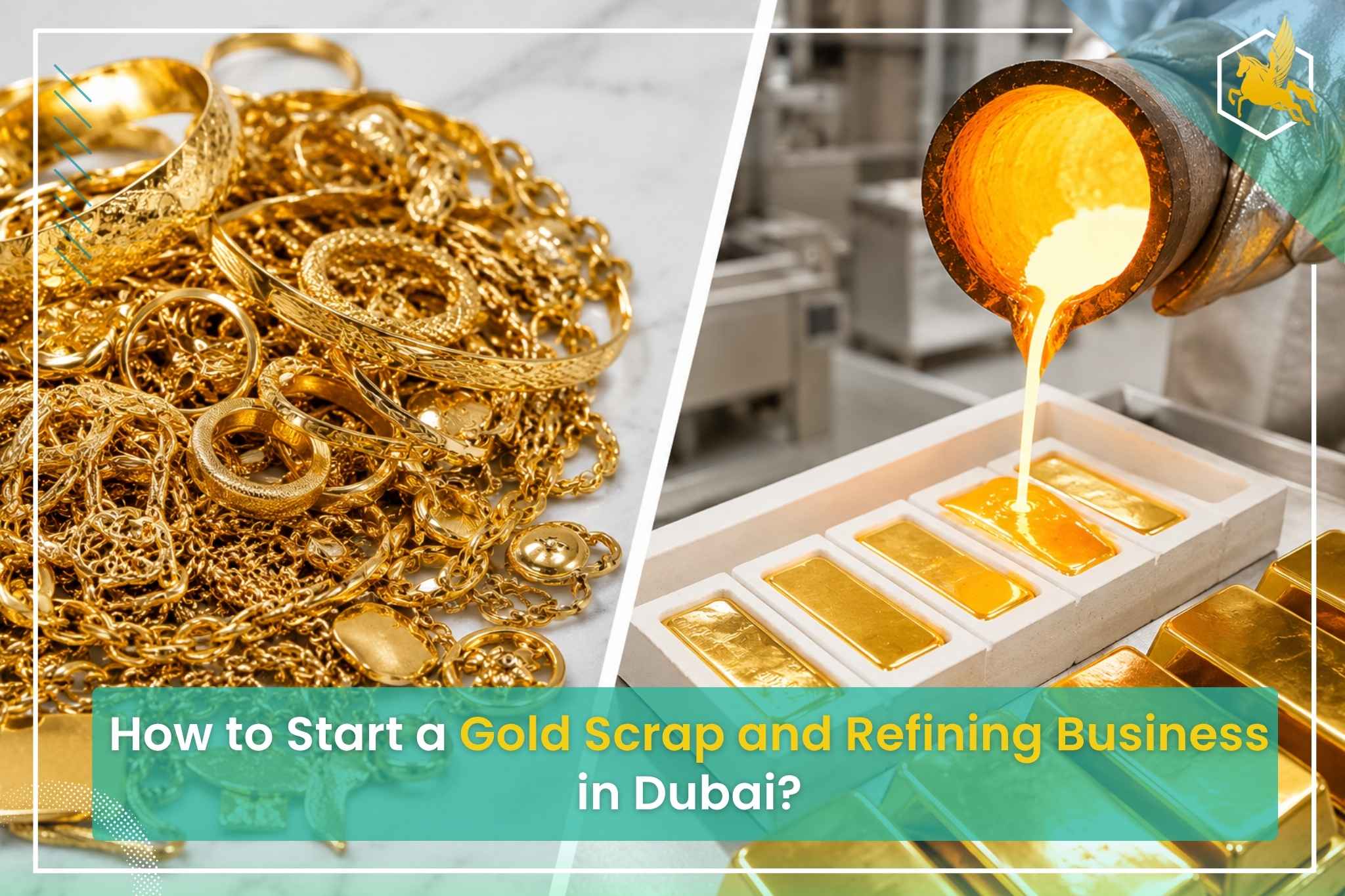
Dubai has long been the beating heart of the global gold trade — and for good reason. With world-class infrastructure, investor-friendly regulations, and a strategic location bridging East and West, the emirate offers an exceptional environment for entrepreneurs looking to enter the precious metals space. Whether you are an Indian entrepreneur seeking upstream integration, a Gulf-based investor exploring new revenue streams, or an experienced jeweller ready to scale your operations, understanding how to establish a Gold Refinery Business in UAE is the critical first step. This guide walks you through every essential detail — from licensing and jurisdiction selection to costs, compliance, and revenue channels — so you can make informed decisions before committing capital.
What Is a Gold Scrap and Refining Business?
A gold scrap and refining business purchases used, broken, or industrial gold in impure form, processes it through chemical or thermal refining to achieve high levels of purity (typically 99.5% or above), and then resells the refined gold to manufacturers, exporters, or commodity exchanges for a profit.
Who Is This Business For?
This business model is particularly well-suited for:
- Indian entrepreneurs seeking to integrate refining upstream into their jewellery supply chain
- Gulf-based investors looking for a regulated, asset-backed business with strong margins
- Jewellers scaling upstream who want to control raw material costs and purity standards
Is Gold Scrap Refining Legal and Profitable in Dubai?
Yes — absolutely. Gold scrap refining is not only legal in Dubai but is actively encouraged through structured regulatory frameworks. When set up correctly, with the right licence and compliance architecture, it is one of the most profitable trade activities available to foreign and local investors alike.
Dubai's Gold Market by the Numbers
The scale of Dubai's gold economy is staggering and provides enormous commercial opportunity:
- Approximately 25% of global gold trade passes through Dubai, making it one of the world’s most significant gold hubs
- The Dubai Multi Commodities Centre (DMCC) hosts over 1,400 precious metal companies, creating a dense ecosystem of buyers, sellers, refiners, and logistics providers
- Dubai’s Gold Souk in Deira is one of the largest gold markets in the world by retail volume
Licences and Approvals You Need
This is the most critical section for anyone pursuing a Gold Refinery License in Dubai. Choosing the wrong licence type can result in regulatory penalties, delayed operations, and wasted expenditure. The UAE has a well-defined licensing structure specifically for precious metals businesses.
Two Core Licence Paths
- DMCC Precious Metals Licence (Free Zone) This licence is designed for businesses focused on gold refining, international trade, and export. It allows 100% foreign ownership, zero corporate tax on qualifying income (subject to conditions), and direct access to DMCC’s trade infrastructure, including the Dubai Gold & Commodities Exchange (DGCX). This is the recommended pathway for any business intending to refine gold and sell into international markets.
- Dubai Mainland DED Licence Issued by the Department of Economic Development (DED), this licence governs local trading activities. It is the appropriate choice for businesses whose primary activity involves purchasing scrap gold from local jewellers, pawnbrokers, and retailers within the UAE. Mainland entities can trade directly with the local market without free zone restrictions.
Additional Regulatory Approvals
Beyond the base trade licence, the following approvals are mandatory and must be sequenced correctly:
- Dubai Municipality Environmental Clearance — Required for any physical refining activity involving chemical processes or furnaces. This approval must be obtained before signing a lease on refining premises.
- CBUAE / DMCC AML Compliance Registration — Gold dealers are classified as Designated Non-Financial Businesses (DNFBs) under UAE law, which means mandatory registration on the goAML platform operated by the UAE Financial Intelligence Unit.
- UAE Central Bank Reporting — Cash transactions above AED 55,000 must be reported. Businesses handling high-value transactions must maintain robust transaction monitoring systems.
Where to Set Up: DMCC vs Mainland for Gold Refining
Factor | DMCC Free Zone | Dubai Mainland |
Best suited for | Refining + international export | Local scrap sourcing from jewellers |
Foreign ownership | 100% permitted | Up to 100% (post-2021 reforms) |
Corporate tax | Qualifying income may be exempt | 9% on profit above AED 375,000 |
Access to local market | Restricted (requires local agent or distributor) | Unrestricted |
Refining activity | Permitted with proper approvals | Permitted in designated industrial zones |
International credibility | Very high (DMCC globally recognised) | Moderate |
Can You Combine Both?
Yes — and for serious operators, this dual entity strategy is often the most effective structure. A DMCC entity handles refining operations and export, while a Mainland DED-licensed company sources scrap from local jewellers and repair shops. The two entities operate in a compliant buyer-seller relationship. This approach maximises both local sourcing access and international trade capability, and is commonly used by established Best Gold Refinery Business Setup in Dubai operators.
Step-by-Step Setup Process
Setting up a gold refining business involves more regulatory touchpoints than a standard trading company. The sequence matters — completing steps out of order is a leading cause of cost overruns and delays.
6 Steps to Launch
- Choose Your Jurisdiction — Decide between DMCC, Mainland, or a dual-entity structure based on your primary revenue model (export vs. local sourcing).
- Reserve Trade Name and Apply for Licence — Submit your chosen business activity codes and trade name for approval. For precious metals, activity descriptions must precisely match the permitted categories.
- Obtain Dubai Municipality Refining Approval — Apply for environmental and operational clearance for refining activity before committing to any premises.
- Lease Approved Premises — Refining operations require industrial or commercially zoned space with adequate ventilation, chemical handling facilities, and fire suppression systems. Standard office or retail space is not permitted.
- Register for VAT and AML Compliance — Complete VAT registration with the Federal Tax Authority and register on the goAML platform for AML/CFT compliance. Appoint a Compliance Officer if required.
Open a Corporate Bank Account — Gold-related businesses face enhanced due diligence from UAE banks. Prepare a comprehensive corporate pack including your business plan, source of funds documentation, supplier agreements, and AML policy. Allow additional processing time compared to standard trading companies.
Capital Investment and Cost Breakdown
Understanding the Cost of Opening a Gold Refinery in UAE is essential for accurate financial planning. The figures below represent realistic 2025 estimates for a small-to-mid-scale refining operation.
Estimated Startup Costs (2025)
Item | Estimated Cost (AED) |
Licence and Registration Fees | 50,000 – 70,000 |
Refining Equipment (furnace, assay tools, chemical systems) | 80,000 – 2,50,000 |
Premises Annual Lease (industrial/approved space) | 40,000 – 1,00,000 |
AML and Compliance Setup (software, officer, policies) | 10,000 – 20,000 |
Working Capital for Initial Gold Stock | 2,00,000+ |
Total estimated first-year investment: AED 3,80,000 to AED 6,40,000 or more, depending on scale and equipment quality. Working capital requirements will vary significantly based on the volume of gold you intend to process.
How to Source Gold Scrap in Dubai
Legal Scrap Sourcing Channels
The UAE has well-defined channels through which licensed refiners may legally acquire scrap gold:
- Licensed jewellery retailers and repair shops — The most reliable and compliant source, particularly for hallmarked items
- Pawnbrokers and gold exchange counters — High-volume sources of mixed-purity scrap
- Industrial scrap — Electronic components, dental alloys, and manufacturing offcuts containing recoverable gold
- Auction houses and estate sales — Occasionally viable for bulk acquisition of older jewellery and gold items
What You Cannot Do
UAE law imposes strict prohibitions that must be understood before commencing operations:
- You cannot purchase gold from unlicensed individuals without completing full KYC (Know Your Customer) documentation, including identity verification and source of funds confirmation.
- Cash payments above AED 55,000 per transaction must be reported to the UAE Financial Intelligence Unit via goAML. Failure to report is a criminal offence under UAE AML law.
Refining Process and Purity Standards
Industry Benchmarks to Know
Buyers and exchanges demand internationally recognised purity certifications. Understanding these standards before you invest in equipment will help you avoid costly retrofits later:
- LBMA Good Delivery Standard — The benchmark for international bullion markets, requiring a minimum purity of 99.5% for gold. Bars meeting this standard are accepted on all major commodity exchanges.
- Dubai Good Delivery (DGD) — DMCC’s own hallmarking standard, which certifies gold bars refined and assayed within the UAE. DGD-certified bars carry significant market premium in regional trade.
- Fire Assay vs. XRF Testing — Fire assay is the gold standard (literally) for determining precise purity and is required for LBMA and DGD certification. X-ray fluorescence (XRF) testing is a rapid screening tool suitable for initial scrap assessment but is not accepted as the sole certification method for export-grade refined gold.
Selling Your Refined Gold: Revenue Channels
Four Primary Exit Markets
Once refined, your gold can be monetised through several regulated channels:
- DGCX (Dubai Gold & Commodities Exchange) — Trade refined gold on spot and futures markets with international pricing transparency and settlement infrastructure.
- Direct Export to Indian and Asian Refineries — India remains the world’s largest gold consumer, and UAE-refined gold with proper certification commands strong demand from Indian importers.
- Supply to UAE Jewellery Manufacturers — Domestic manufacturers consistently require high-purity gold, and local supply relationships can offer more stable pricing than spot markets.
- DMCC Tradeflow — A digital commodity warrant platform that allows gold to be transferred electronically between DMCC-registered parties, reducing physical handling costs and improving liquidity.
Taxes, VAT, and AML Obligations
This is a standalone compliance reference block designed to provide specific, actionable figures for your financial and legal planning.
Key Compliance Numbers
- VAT: Gold bullion meeting 99% or higher purity is zero-rated under UAE VAT law (Federal Decree-Law No. 8 of 2017, as amended). This means you do not charge VAT on qualifying refined gold sales, significantly improving your competitiveness with international buyers.
- Corporate Tax: The UAE Corporate Tax introduced in 2023 applies a 9% rate on UAE-sourced taxable profit above AED 375,000. DMCC entities in qualifying free zones may benefit from a 0% rate on qualifying income, subject to substance requirements.
- AML: All precious metals dealers are classified as Designated Non-Financial Businesses and Professions (DNFBPs) under UAE Cabinet Decision No. 10 of 2019. Mandatory obligations include goAML registration, Customer Due Diligence (CDD), Suspicious Transaction Reporting (STR), and maintenance of transaction records for a minimum of five years.
Common Mistakes to Avoid
Many entrepreneurs encounter avoidable delays and financial losses when setting up a Gold Refinery Business in UAE for the first time. The following errors are among the most frequently observed:
4 Errors That Delay or Kill the Business
- Leasing premises before confirming refining activity approval — Dubai Municipality clearance for refining activities must be obtained before signing any lease. Landlords rarely offer refunds, and finding alternative approved premises can add months to your timeline.
- Skipping AML registration — The UAE’s AML enforcement framework has become increasingly rigorous. Fines for non-registration are substantial, and in serious cases, business licences may be suspended or revoked.
- Underestimating working capital for gold stock — Gold is a capital-intensive commodity. Many new entrants underestimate the amount of working capital required to maintain meaningful inventory levels and cannot fulfil buyer orders at competitive volumes.
- Using a standard trading licence instead of a precious metals-specific licence — A general import/export or commodities trading licence does not authorise refining activity. Operating outside your licensed activity scope exposes your business to regulatory action and banking complications.
Start Your Gold Refining Business in Dubai the Right Way
Establishing a compliant, profitable gold scrap and refining operation in Dubai requires more than capital — it demands precise sequencing of regulatory approvals, the right jurisdictional structure, and a thorough understanding of UAE AML obligations. The licensing, environmental clearance, and premises approval processes must be completed in the correct order, or costs escalate rapidly and timelines extend significantly. Engaging experienced UAE Gold Refinery Company Formation Services from the outset is strongly recommended to avoid the costly mistakes that many first-time entrants make. With the right professional guidance, a correctly structured gold refining business in Dubai offers exceptional long-term returns in one of the world’s most dynamic precious metals markets.
Reach out to Unicorn Global Solutions L.L.C for a Free Consultation
Frequently Asked Questions (FAQs)
Addresses the foreign ownership concern that every non-UAE investor asks first
Timeline anxiety is universal; this gives honest, stage-by-stage expectations
The most-searched cost question; anchors the cost table with real context
VAT zero-rating and corporate tax are frequent points of confusion
Clarifies a common legal grey area that trips up new entrants